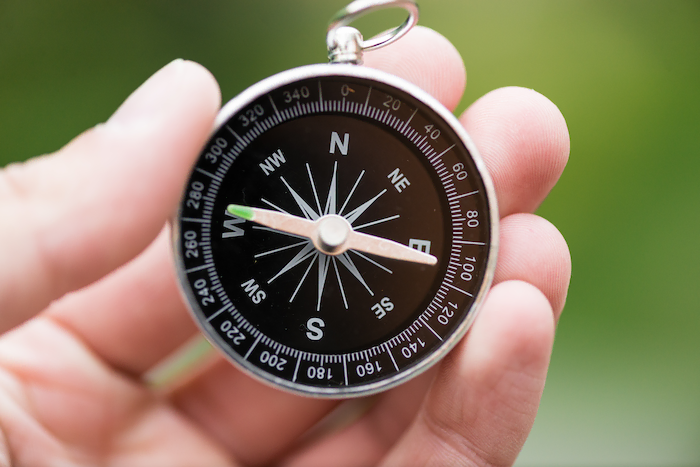
Navigating in the wilderness has been a fundamental skill for travelers, mountaineers, and outdoor enthusiasts for centuries. While GPS and other technological devices have greatly simplified this process, the ability to use a guide becomes vital in situations like battery failure, signal loss, or device malfunction. In this article, we delve into all the details of compass use.

Contents
Types of Compasses and Their Basic Components
Compasses come in various shapes and sizes, but the most common types include:
Basic Direction Finder
- A rotating needle
- A graduated dial
- Liquid to stabilize the needle’s movement
Silva Type Direction Finder
- A flat base
- A scaled ruler with a transparent cover
- A pointer on the dial to read directions and angles
Lensatic Direction Finder
- A foldable cover
- A lens for focusing on a target
- A pointer for precise angle measurements
Digital Direction Finder
- Electronic sensors
- Digital display
- Operates on battery power
How Does a Compass Work?
The working principle of a compass is based on Earth’s magnetic field. The direction finder needle points to the magnetic north, but there is a difference between magnetic north and true north (geographic north). This difference is referred to as “magnetic declination.”
Magnetic Declination
- Varies based on your location
- Indicated on topographic maps
- Expressed in degrees
Adjusting for Magnetic Declination
- Check your direction finder settings
- Add or subtract the magnetic declination from your compass as needed
Finding Directions with a Compass
Identifying Basic Directions
- Place your compass on a flat surface
- Wait for the needle to settle
- Read the basic directions (N, S, E, W) from the dial
Using Azimuth
- Point your guide towards your target
- Rotate the dial until the needle is aligned
- Read the value on the dial; this is the azimuth to your target
Using a Map
- Place your direction finder on the map
- Align the edge of the map with the ruler on your direction finder
- Adjust your azimuth and determine your location
Precautions When Using a Compass in Nature
- Stay away from magnetic fields: Keep your guide away from metal objects and electronic devices.
- Regularly check your compass: A damaged or faulty direction finder can be misleading.
- Consider environmental factors: Wind, weather conditions, and geographical features can affect your navigation.
Advanced Direction Finder Use
Finding Direction with Stars
- Locate the North Star and use it to determine north
- Use your guide to identify other directions
Terrain-Based Navigation
- Use features in your surroundings to determine your location
- Combine geographical features like valleys and hills with your direction finder readings
Quick Calculations and Estimates
- Mentally estimate azimuths and distances
- Take time into account for speed and distance calculations
Compass Maintenance
A direction finder is a critical tool for navigation in the outdoors, and maintaining it properly ensures its accuracy and reliability. This article delves into effective methods and essential tips for compass maintenance.
Cleaning and Storage
Cleaning
- Exterior Surface: Gently wipe the exterior with a damp cloth. Avoid using solvents or abrasive cleaners.
- Needle and Dial: Use a blower or soft brush to clean the inside surface of the direction finder. Removing dust and dirt particles ensures the needle moves freely.
Storage
- Store your direction finder away from direct sunlight and high temperatures.
- Keep it away from magnetic fields; these can disrupt the compass’s calibration.
Routine Checks and Adjustments
Needle Movement
- The needle of your compass should move freely and settle quickly. If the needle sticks or moves slowly, this could indicate a problem.
Accuracy Test
- Use a known direction to test the accuracy of your direction finder. For example, you can use the sunrise or sunset.
Preventive Maintenance
Protective Case:
- Store your guide in a protective case to shield it from impacts and scratches.
Moisture and Corrosion:
- Moisture inside the direction finder can hinder the needle’s proper functioning. If there is moisture, seek professional help.
- Check the metal parts and take measures against corrosion.
Professional Maintenance and Repair
If your direction finder is significantly damaged or experiencing calibration issues, seek professional maintenance or repair services. Attempting to fix the internal mechanism on your own could cause further damage.
Points to Consider During Maintenance
- Avoid dropping your compass on hard surfaces.
- Keep it away from chemical substances and solvents.
- Protect your compass from extreme hot or cold conditions.
Conclusion
A direction finder is a critical tool in wilderness navigation and, when used effectively, can keep you on the right path. Learning the basic skills of direction finder use, practicing regularly, and carefully reading the signs in your environment will contribute to a safe and enjoyable experience in nature. These skills enable you to master compass use and feel more confident in the wilderness.
- Selecting a Refrigerator for Your Caravan: What to Consider?
- Camper Photography
- Information About Campfire
- Things to Consider When Choosing a Campground
- Outdoor Furniture – The Key to Outdoor Comfort
Follow us on social media